
January, again

A new year comes around, and we intend (but mostly pretend) to start afresh. That we do so by repeating the same old rituals is telling. The year begins where December left off: mid-sentence, mid-project, mid-confusion. Whatever was unfinished remains unfinished. Whatever was uncertain stays that way. That pile of stuff you didn’t get to. It didn’t just vanish at midnight; it’s still there.
Many of us face the usual New Year questions. What will I accomplish? What goals will I set? What habits will I build? What new version of myself will I become by next December?
As I get older, I find myself unable to take these questions seriously; perhaps I am worn down by my repeated failure to achieve those goals or establish those habits. But, to be fair to myself, I also have better questions these days. Not, “what will I accomplish?” but, “what needs my care?”
The first assumes I know what is worth doing. It’s incredibly self-assured, isn’t it? You’ve already defined success, now (in tech industry terms), you just need to execute; it’s all about output.
But the other question, “what needs my care?” at least admits that you don’t know the plan. But you do know what is worth caring about. Is this what being a grandparent does to you?
Belief in work
Somewhere in the last few decades, work became a religion for many people like me. I use “religion” deliberately. Religion is something to care about, outside of our immediate personal and family needs. Religion organizes our attention and gives shape to our time by observance and ritual.
Look, then, at the professional classes, the knowledge workers, the credentialed strivers: we made work the thing around which everything else arranges itself. Family too often fits in the gaps; rest and leisure only prepare us to return to work refreshed.
I know this now, but I have known about it for years without breaking free of it. I could describe the trap, but I remain caught in it. There is a difference between knowing that something is true and knowing what it is like to live otherwise.
A resolution to “work less” or to find a better balance fails because it is an act of will directed at the self, and the self cannot transform itself through willpower alone. This is the error of the Stoics (so popular again on the internet), who believed that right thinking could produce right living. But attention is something quite different from will. Attention is a form of waiting, a receptivity to what might arise. When you ask, “What will I accomplish?” you have already enclosed yourself in a model of the world where you are at the center. The better question, “what needs my care?”, opens you up to a world of very different answers. Perhaps it is a form of prayer, even if you do not call it that.
Most of the conversations we have in the tech sector about work (and the dead phrase “work-life balance”) concern a particular kind of tiredness: professional burnout, the exhaustion of those who chose their overwork and could, in principle, choose otherwise. Don’t dismiss this; it is suffering, even if the peculiar suffering of those who exploit themselves. I expect it is precisely this self-chosen quality of suffering that makes escape so difficult. But it is not the only kind.
Other exhaustions
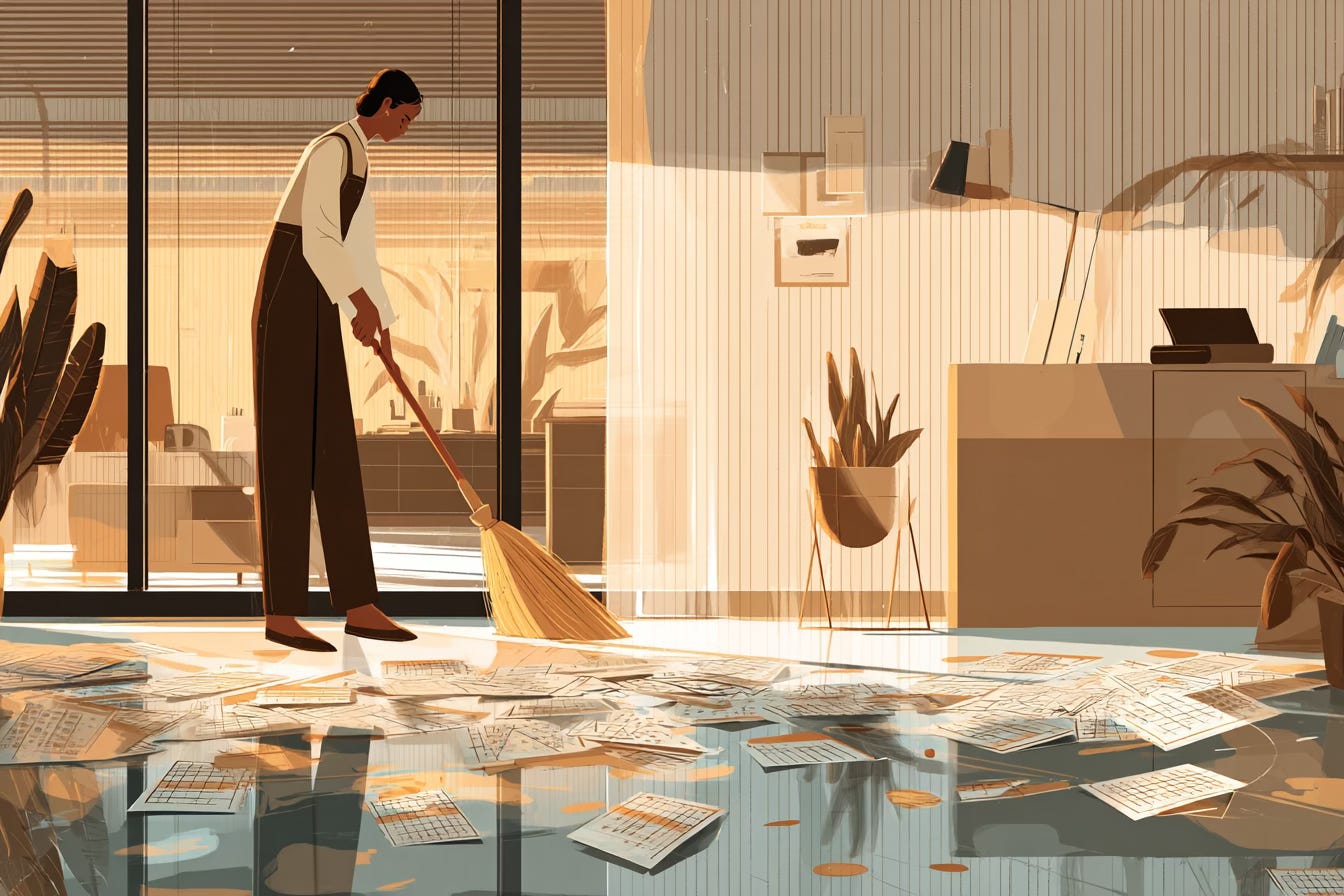
The shift worker timed by the algorithm is worn out. So is the cleaner who must work late into the evening, or the barista who must rise hours before dawn, so that everything is ready for the knowledge workers, who will in turn complain about their busyness. Parents, but still mostly mothers, find that their rest is interrupted before it begins; family carers whose labour goes unpaid are drained emotionally and physically.
These exhaustions are not spiritual problems awaiting reorientation. None of my New Year’s questions offer a way out, or are even relevant. No amount of philosophical pondering about your orientation of mind is going to give you your sleep back. Your exhaustion isn’t a psychological problem; it’s an economic and political one. It’s the product of a system that needs your cheap labour, or a mother’s free labour, to function. These exhaustions are material, political, and structural.
The cleaner does not need a meditation app, nor the Amazon factory worker, a so-called Zen Booth). They need higher wages, shorter hours and better conditions. No amount of asking “what needs my care?” will give these people their sleep back, because they are already drowning in the demands and needs of others: their problem is that no one is asking what they need.
So, I keep returning to the uncomfortable question: whose labour makes my choices possible? Who gave me the luxury of worrying about burnout? Someone is working so that I can ask these questions, which are, frankly, luxuries. I know very well that my choices rest on the labour of others, but nevertheless, I continue as before.
I do not have a programme to offer. I am suspicious of programmes, especially in January and when they promise transformation. Modern society has an enormous capacity to absorb its own criticisms and sell them back to you as a product. Everything is available as a lifestyle option, including the critique of lifestyle options. You can buy books about the tyranny of consumer capitalism at the airport bookshop.
So all I have now is that question: what or who needs my care? I can’t be satisfied with answers that came too easily: no AI chat is going to help me here. I have a sense that the year ahead will ask something of me that I cannot yet describe, a demand for care that hasn’t even shown up.
But let us not be too pious about this. The year will ask me to get up in the morning and do things. It will ask me to make decisions that have consequences for others. I had best get on with it.
It might be 'January, again' but I've found your new year message quite uplifting. For example this brilliant piece of self-awareness of which I'm just as knowingly culpable:
"I know this now, but I have known about it for years without breaking free of it. I could describe the trap, but I remain caught in it. There is a difference between knowing that something is true and knowing what it is like to live otherwise."
The question 'who or what needs my care?' is the antidote for all new year's resolutions from this day forth. Happy New Year to you and yours.
That's a lot of introspection, my friend. I like it. Perhaps instead of goals, we could try in 2026 to keep a set of questions before us, so that we might be focused outward on sensitivity and adaptation to whatever life brings, rather than driving through some blind a priori plan. Some suggestions...
What dogmas that I’ve refused to compromise am I willing to open up for discussion?
What parts of my cultivated identity -- with others and with myself — are in need of refurbishment?
What cherished sacred-cow priorities might I need to downgrade in order to make space for newly important things?
What of me has not changed in too long, has calcified into something that prevents fluidity and adaptation in my life — my self, my routines, my skills, my relationships, my services to others? And, what would it look like to loosen up those calcified joints a little, to improvise when life presents me with something new or novel?
Where have I been taking too much risk, or too little?
Where do I enjoy the benefits of grace, luck, or coincidence in my life, and how might I find new avenues to experiment with sharing similar graces with others?
What or whom do I wish I were less ignorant about?